A week on the Costa del Sol is a holiday. Stay for a month or two and the experience becomes completely different.
You stop thinking about which attraction to visit tomorrow and start wondering where to buy good bread, which supermarket you prefer, whether you really need a car and which café makes a good place to open the laptop for a couple of hours.
For many people, that is exactly the appeal. The Costa del Sol works particularly well for longer stays because it combines mild weather, established international communities, good transport connections and towns where everyday life continues throughout the year.
It is also actively positioning itself as a destination for remote workers and digital nomads, with coworking spaces, flexible accommodation and remote-working infrastructure promoted by the Costa del Sol tourism authority itself.
But where should you stay? How much should you budget? And what is daily life actually like once the holiday feeling wears off?
Here is what to know before spending one, two or three months on the Costa del Sol.

Why stay for a month instead of a week?
The obvious answer is the weather, but that is only part of it.
A longer stay allows you to enjoy the Costa del Sol at a much slower pace. Instead of trying to squeeze Málaga, Marbella, Mijas and Granada into seven days, you can spend an ordinary Tuesday walking along the beach, discover restaurants away from the tourist streets and take day trips whenever you feel like it.
It can also make particular sense between roughly October and May.
Summer is when the Costa del Sol is at its busiest and accommodation prices are generally highest. Outside the peak season, beaches and promenades become noticeably quieter while most larger towns remain very much alive.
Winter here doesn’t mean guaranteed beach weather every day. There are rainy periods, windy days and evenings when you will definitely want a jacket.
But there can also be wonderfully sunny winter afternoons when sitting outside for lunch seems perfectly normal.
For people escaping northern European winters, that contrast is a major attraction.
Where is the best place for a long stay on the Costa del Sol?
There is no single best town.
A place that is perfect for a weekend can be surprisingly inconvenient when you stay for six weeks. For a longer stay, supermarkets, public transport, walkability and year-round restaurants become much more important.
Málaga: best for city life
Choose Málaga if you want the biggest selection of restaurants, museums, shops, nightlife and cultural events.
It feels much more like a real Spanish city than a holiday resort.
You can live perfectly comfortably without a car, Málaga Airport is close and the main railway station gives you easy connections further into Andalucía and Spain.
For remote workers, it also offers one of the largest selections of coworking spaces and cafés.
The downside is price.
Málaga has become considerably more expensive in recent years. In September 2026, asking rents averaged around €16.50 per square metre across the city, with central Málaga at approximately €17.50/m².
For a few months, furnished short-term accommodation can cost considerably more than those standard residential averages.
Best for: city lovers, digital nomads, younger visitors and people who want to live without a car.
Torremolinos: convenient and surprisingly practical
Torremolinos sometimes gets dismissed as simply a package-holiday resort, but for a longer stay it has several advantages.
It is extremely well connected.
The C1 Cercanías train connects Torremolinos with Málaga, Málaga Airport, Benalmádena and Fuengirola.
There are plenty of supermarkets, restaurants and services, and you can easily manage without owning a car.
The town also remains active outside summer.
Best for: people wanting easy transport, nightlife, beaches and quick access to Málaga.
Benalmádena: a good all-round compromise
Benalmádena sits somewhere between resort life and everyday residential life.
Around Arroyo de la Miel you have shops, supermarkets, restaurants and the train station, while Benalmádena Costa puts you closer to the beach and marina.
For a long stay, Arroyo de la Miel can actually be more practical than immediately living beside the sea.
Benalmádena is particularly popular with families and international residents.
Best for: families and people wanting a balance between resort life and normal daily living.
Fuengirola: perhaps the easiest place for a longer stay
Fuengirola deserves serious consideration if you plan to spend several months here.
It is compact, flat and extremely walkable.
The town has supermarkets, shopping centres, gyms, cafés, restaurants, medical services and one of the longest seafront promenades on the Costa del Sol.
You could easily go several weeks without needing a car.
Fuengirola and Los Boliches also have stations on Málaga’s C1 Cercanías line. The same railway connects directly with Málaga Airport and Málaga city.
There is a substantial international population, so getting by with English is relatively easy, although learning some Spanish will obviously improve the experience.
Fuengirola isn’t particularly cheap anymore. Average asking rents were around €17.20/m² in September 2026, up 6.8% compared with a year earlier.
Still, its combination of convenience, beach life and transport makes it one of the easiest places to test the Costa del Sol lifestyle.
Best for: first-time long stays, retirees, remote workers and anyone without a car.
Mijas and La Cala de Mijas: quieter coastal living
Mijas is slightly complicated because “Mijas” can describe very different places.
Mijas Pueblo is the famous white village in the mountains.
La Cala de Mijas is a small coastal town.
Las Lagunas is a large residential area next to Fuengirola.
Then there are many urbanisations spread between them.
La Cala has become increasingly popular because it offers a more relaxed environment than Fuengirola while still having restaurants, supermarkets and a pleasant beach.
For a month or two, however, location matters enormously.
Stay in central La Cala and you can walk almost everywhere. Rent an attractive apartment in an urbanisation several kilometres inland and you may suddenly find a car essential.
That distinction is easy to overlook when booking online.
Mijas asking rents averaged approximately €17.10/m² in September 2026.
Best for: people looking for a quieter lifestyle who don’t mind driving.
Marbella: lifestyle first, budget second
Marbella offers excellent restaurants, beaches, shops, golf courses and nightlife.
It is also one of the most international areas on the coast.
If budget is less important, spending several months around Marbella can be fantastic.
The challenge is transport.
Unlike Málaga, Torremolinos, Benalmádena and Fuengirola, Marbella does not have a Cercanías railway station. Buses are available, but living here is considerably easier with a car depending on your exact location.
Accommodation is also expensive. Marbella’s average asking rent stood at approximately €23.60/m² in September 2026, one of the highest levels in Málaga province.
Best for: luxury lifestyle, golf, restaurants and people with a larger accommodation budget.
Estepona: increasingly attractive for long stays
Estepona has changed enormously over the past decade.
Its attractive old town, long promenade, restaurants and expanding residential areas have made it much more than an alternative to Marbella.
It feels somewhat calmer and more Spanish than parts of Marbella while still offering an increasingly sophisticated restaurant and leisure scene.
Again, having a car makes life easier.
Prices have also risen substantially, with average asking rents around €21.10/m² in September 2026.
Best for: couples, retirees and anyone seeking a polished but slightly calmer Costa del Sol lifestyle.
Which town should you choose?
As a quick rule of thumb:
| If you want… | Consider |
|---|---|
| City life | Málaga |
| Excellent airport connections | Torremolinos |
| Family-friendly living | Benalmádena |
| Walkability and convenience | Fuengirola |
| Relaxed coastal living | La Cala de Mijas |
| Luxury and nightlife | Marbella |
| A quieter upscale atmosphere | Estepona |
For a first long stay, Fuengirola or Málaga are probably the safest choices because both make daily life particularly easy.
How much does a 1–3 month Costa del Sol stay cost?
There is no particularly useful single monthly number because accommodation changes the calculation completely.
A couple renting a beachfront apartment in Marbella will obviously spend very differently from someone renting a small apartment in Fuengirola in November.
The biggest expense is normally accommodation.
And one important distinction is that the normal residential rental prices you see quoted in property-market statistics do not necessarily represent what you’ll pay for a furnished one- or two-month rental.
Short-term and seasonal rentals commonly carry a premium.
When comparing apartments, check whether the advertised price includes:
- electricity
- water
- internet
- community fees
- final cleaning
- parking
- agency fees
Electric heating or air-conditioning can make utility costs particularly relevant.
Groceries
If you’re coming from northern or central Europe, supermarket prices will probably feel fairly familiar rather than extraordinarily cheap.
Mercadona, Carrefour, Lidl, Aldi and Día are easy to find along much of the coast.
Shopping at local fruit shops, butchers and markets can be both enjoyable and good value.
Eating out
One of the advantages of a longer stay is that you stop eating every meal as if you’re on holiday.
There are still inexpensive local cafés where breakfast might simply be coffee and a tostada, alongside high-end restaurants where dinner can easily cost €100 or more.
A good strategy is to eat where local residents eat during the week and save the beachfront restaurants for when the view is part of the experience.
Do you need a car?
This question can completely change where you should stay.
If you live in:
Málaga, Torremolinos, central Benalmádena or Fuengirola: probably not.
If you live in:
La Cala de Mijas, Marbella or Estepona: maybe.
If you live in:
an inland urbanisation: quite possibly.
The C1 Cercanías railway is particularly useful. It runs between Málaga and Fuengirola and serves Málaga Airport, Plaza Mayor, Torremolinos and Benalmádena along the way.
That makes the eastern half of the western Costa del Sol dramatically easier without a car.
One mistake long-stay visitors sometimes make is choosing an apartment based purely on the sea view.
A beautiful hillside apartment may be cheap and spectacular, but walking back from the supermarket carrying six litres of water can quickly change your opinion of it.
For a multi-month stay, check the map carefully before booking.
What is the Costa del Sol like in winter?
Winter may actually be the best season for a longer stay.
You won’t get guaranteed sunshine every day, and January or February can bring rain and cool spells.
But there are also plenty of days suitable for walking, cycling, sitting on a terrace or eating lunch outside.
More importantly, the coast feels different.
The beaches become quieter, parking gets easier and popular promenades return to everyday local life.
In larger towns such as Málaga and Fuengirola, restaurants and shops remain open because hundreds of thousands of people actually live here.
That makes the Costa del Sol very different from purely seasonal beach destinations that effectively shut down in winter.
Can you work remotely from the Costa del Sol?
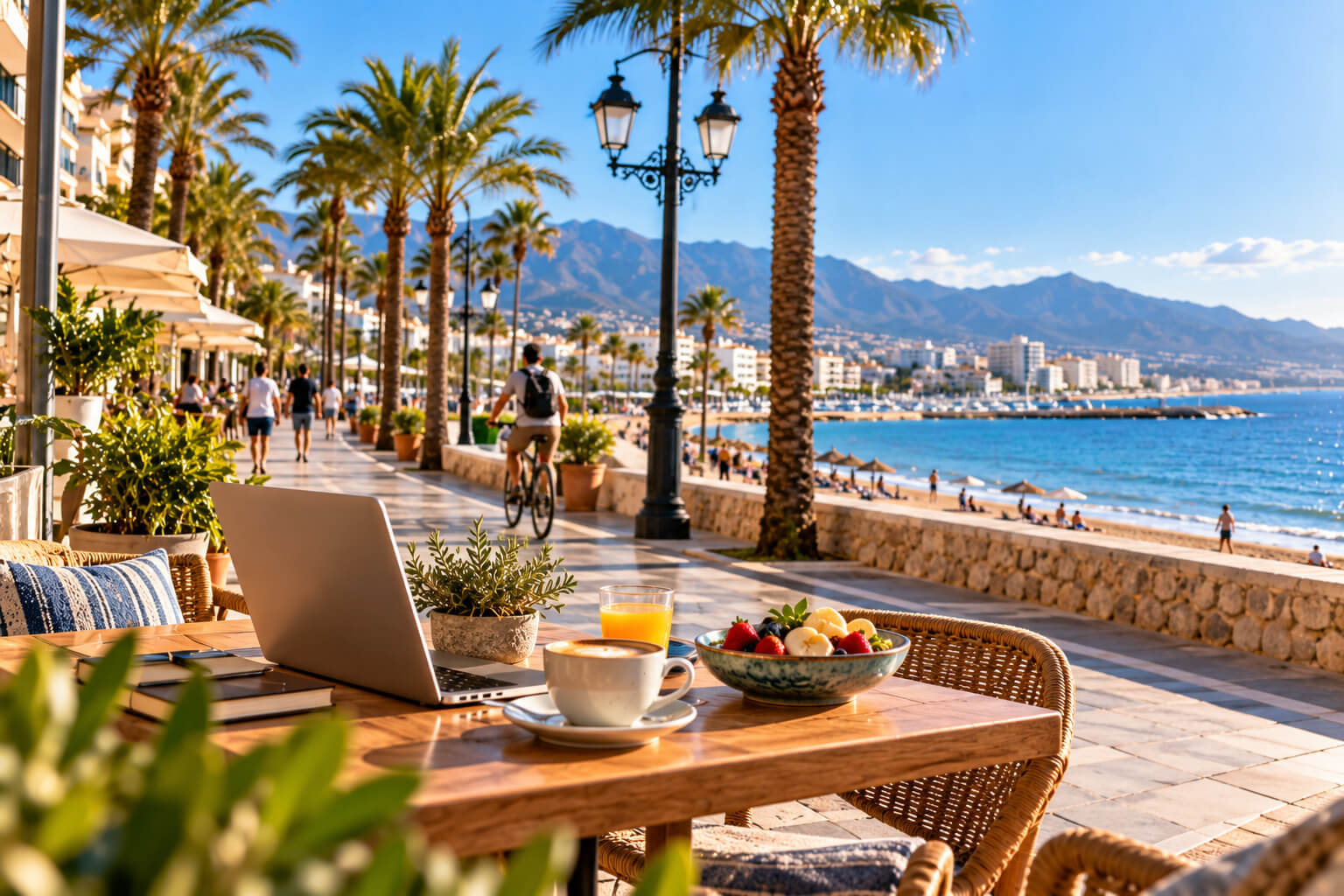
Yes, and increasingly many people do.
Reliable fibre internet is widely available, there are numerous coworking spaces and mobile coverage is generally good throughout the main coastal towns.
Costa del Sol tourism authorities now specifically promote the region to remote workers, including coworking, coliving and flexible accommodation.
That doesn’t mean every holiday apartment is suitable for work.
Before booking, ask specifically about:
Internet speed. “Wi-Fi included” tells you almost nothing.
Desk space. Working for eight hours from a bar stool gets old quickly.
Noise. An apartment above a lively bar may be wonderful during a weekend and terrible during a Monday morning video meeting.
Heating and cooling. You’ll notice poor insulation much more when spending full working days inside.
And don’t underestimate the value of having somewhere outside your apartment to work occasionally.
A coworking space can also be one of the easiest ways to meet people during a longer stay.
What about visas and the 90-day rule?
EU citizens have freedom of movement within the EU, although additional residence formalities can apply when staying longer.
For many non-EU visitors, the key number is 90 days.
Schengen short-stay rules generally allow eligible non-EU nationals to remain in the Schengen Area for no more than 90 days within any rolling 180-day period.
That limit applies across the Schengen Area collectively, not simply Spain.
So spending 60 days in Spain after already spending 50 days in France would not reset the calculation.
Anyone planning a stay approaching three months should check the rules that apply to their nationality before booking.
People intending to live and work remotely from Spain for considerably longer may also want to investigate Spain’s Digital Nomad Visa, which the Costa del Sol tourism authority specifically highlights for remote workers.
What should you look for in a long-stay apartment?
The requirements are surprisingly different from those of a holiday apartment.
A rooftop pool may look great in photos, but after six weeks you might care much more about having a washing machine and a decent kitchen.
For a stay of one month or longer, look for:
A proper washing machine. Laundrettes become annoying surprisingly quickly.
Fast internet. Especially if you’re working remotely.
Heating or air-conditioning with heating mode. Spanish homes can feel colder inside during winter than visitors expect.
A supermarket within walking distance.
Outdoor space. Even a small balcony dramatically improves longer stays.
A comfortable sofa and bed.
Good natural light.
A realistic distance from the beach. “800 metres from the sea” could involve a very steep hill.
Parking if you’re renting a car.
For winter stays, also look at the orientation of the apartment.
A sunny south-facing terrace can be glorious in January. A permanently shaded apartment may feel quite different.
Is English enough?
In the major tourist areas, you can generally survive with English.
In Fuengirola, Benalmádena, Marbella and many parts of Mijas, encountering restaurant menus, estate agents and businesses operating in several languages is completely normal.
But surviving and experiencing a place are different things.
Even a small amount of Spanish changes everyday interactions.
Start with simple phrases for cafés, supermarkets and greetings. Nobody expects perfection.
Making an effort usually goes a long way.
What do you actually do for several months?
This is one of the nicest parts of staying longer.
You don’t have to do anything every day.
Your weeks can start resembling normal life:
Monday might be work.
Tuesday might include a walk along the promenade.
Wednesday could mean driving into the mountains for lunch.
Saturday might become a day trip to Málaga, Ronda, Nerja or Granada.
And Sunday might involve nothing more ambitious than coffee beside the sea.
That is precisely the point.
Once you stop treating the Costa del Sol as somewhere that must be “seen” within seven days, it becomes somewhere you can simply live.
Good day trips during a longer stay
One major advantage of using the Costa del Sol as a temporary base is how much of Andalucía is within reach.
Over several weeks, you can gradually explore:
- Málaga city
- Ronda
- Granada and the Alhambra
- Nerja
- Frigiliana
- Mijas Pueblo
- Caminito del Rey
- Antequera
- Gibraltar
- Cádiz
- Córdoba
- Seville
Some are straightforward day trips. Others are better as an overnight stay.
With two or three months available, there is no reason to rush them.
One month, two months or three?
One month is long enough to get beyond the normal holiday experience.
You’ll begin developing routines and discover whether you actually like living here rather than simply visiting.
Two months gives you enough time to explore Andalucía without feeling constantly on the move.
Three months starts feeling surprisingly close to normal life.
By that point you will probably have a favourite supermarket, café, restaurant and walking route.
And that might be when the dangerous thought appears:
“Could I actually live here?”
For quite a few Costa del Sol residents, that question was where the story started.
Is a long stay on the Costa del Sol worth it?
If what you want is guaranteed tropical heat, extremely cheap living or deserted beaches all year round, probably not.
The Costa del Sol has become more expensive, traffic can be frustrating and some areas are heavily developed.
But its strength is how easy life can be.
You have an international airport, modern infrastructure, beaches, mountains, restaurants, shopping and centuries-old Andalusian towns all within a relatively small area.
And outside the busiest summer months, you get to see a side of the Costa del Sol that a one-week visitor often misses completely.
For anyone curious about life in southern Spain, spending one to three months here may be the best way to find out whether the Costa del Sol is simply somewhere you enjoy visiting — or somewhere that begins to feel a little like home.